VISUAL LANGUAGE
The purpose of this page is to describe my system of communication expressed in my work, as supporting documentation for any specific project presented. The elements of line, shape, color, texture, and composition are defined by the processes I explore and is based on my hand-drawn illustration style.Description
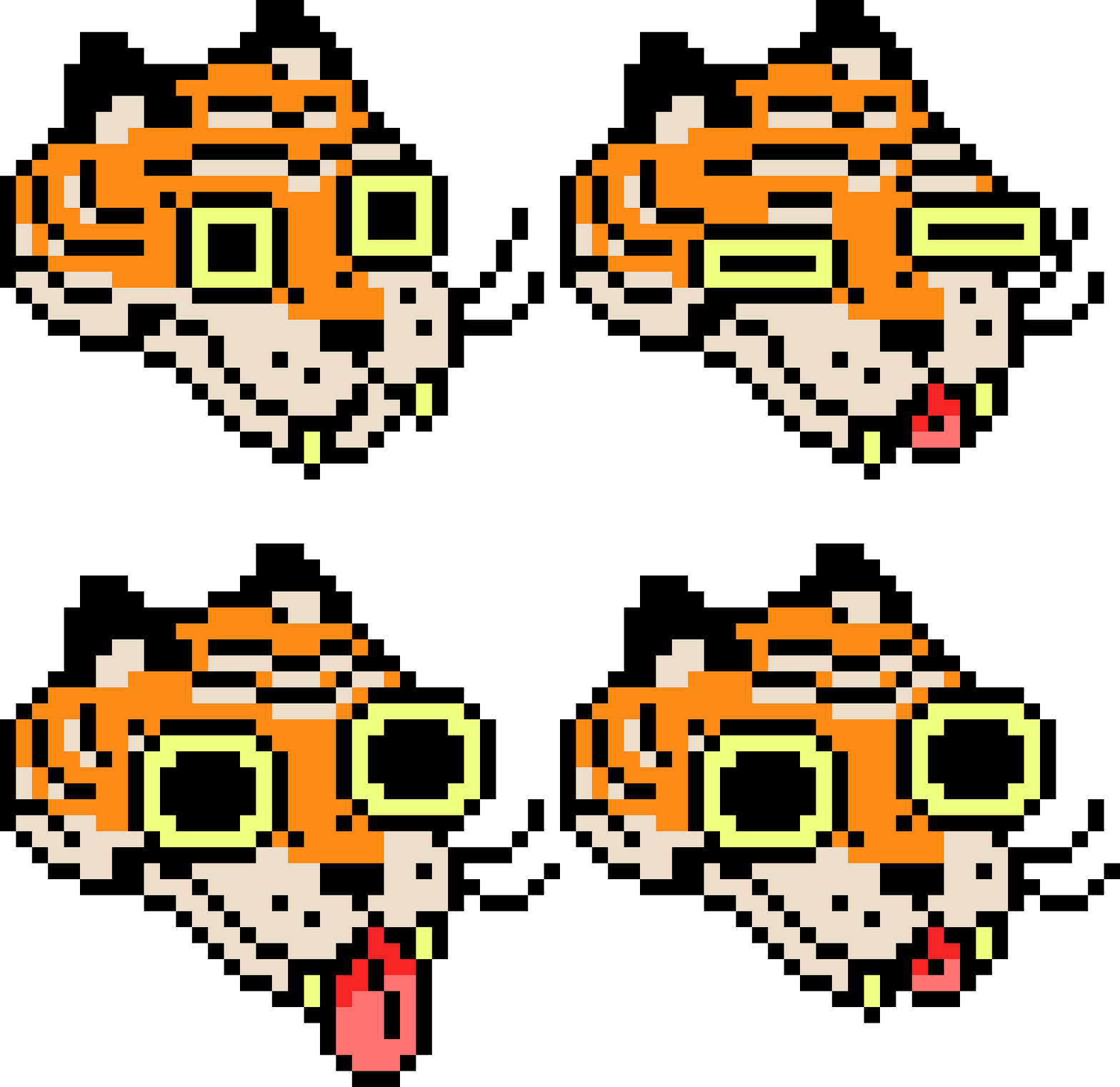
My work explores my identity and is a means of self-expression and communication. My visual language is based on illustration and narrative and follows original characters representing aspects of my identity. Their dialogue and presence signify my inner dialogue with myself as I navigate life in this world.The presentation of the work is often a single highlighted character or a collection of individual objects or characters. Designs are flat, ornamental, and focus on decoration rather than realism. I use stacked, flattened, or atmospheric perspective commonly found in Asian painting. I also reference collections of objects or diagrams like in scientific illustration. The art style is representational with abstract and exaggerated features, focusing on lines and fields of colors contrasting sections of dense patterning. Line work is consistent depth and architectural, involving parallel and intersecting curved lines often seen in technical drawing. Patterns and textile designs are derived from my hand-drawn style, further deforming sections of illustrations into smaller forms that together build larger, repeated sections.Subject matter is self-soothing and reflective on quiet moments in life, such as nature themes and animals. Although rare, depicted acts of violence are usually reflections of my own inner turmoil. Humanoid creatures are autobiographical and a reflection of my perception of self through gender identity.Outside of composition and design, processes employed to create art are also self-soothing and involve mindfulness meditation and repetitive mark-making.Process & Mediums
I currently create work for Tigerbob and as an independent artist in the following manners:Illustration: Drawings produced with dry media on paper, often built up or layered with small, repetitive strokes.Tattooing: Ink pushed and preserved in skin by hand without a machine, one mark at a time.Machine Knitting: Textile composed of looped yarn constructed on a bed of needles, completed one row of loops at a time.Digital Art:Code-Based Art: Typing processes including coding and a custom method to transpose illustrations into grids or matrices.Digital Illustration: Drawings produced or completed with the aid of a computer, made with a stylus on tablet or mouse.
Soft sculpture: Textiles sewn together and stuffed or stretched over a surface, usually as a method to finish a work.
Visit this page to learn more about my design and processes.Background (Biography)
The exposure to art begins with my parents. I was born and raised in a rural part of Northeast Pennsylvania, surrounded by the Appalachian mountains and Susquehanna valley. My mother is Filipino and our home was decorated with vintage pieces she took with her from the country. Notable works are of Japanese and Chinese origin: a red four-seasons screen with florals and cranes, and ceramic sculptures of dragons and people. My father is African-American and my favorite pieces of his were ceramic vases and bowls he collected from a friend, and a statue of a Native American man. He also played classical and blues guitar and was well-versed in classical composers like Beethoven and Mozart.I used art to express my identity and to communicate since early childhood. I began taking cello lessons at the age of 4 (1994), discovering the expression of music while I learned to read and write. My earliest awareness of my visual artistic ability occurred at the age of 5, with a four-seasons illustration prompt introduced in kindergarten. In addition to academics, computer classes introduced me to the capabilities of technology in art and design. I spent ample time at libraries intrigued by science, technology, and religious studies, and began to use these concepts to describe my own inner world of characters. Experiences navigating mental and physical health problems showed in my work as a teenager (early 2000s). Art became a coping mechanism for what I was going through, especially when I could not explain what I was experiencing.My interests at this time included video games, manga, anime, and alternative genres of music and fashion. As a child I wanted to design my own card games, video games, toys, and clothing. I started stitching my own plush characters and altered my clothes to better fit my self expression.My work up to this point was mostly self-taught, with some guidance from instructors by method of copying existing paintings verbatim to study technique. Mostly, I would try to make whatever I wanted to exist by research and trial-and-error. I drew what inspired me, and worked that language into my characters as I discovered it.I made the decision not to pursue illustration or painting as a degree at Massachusetts College of Art and Design (2008-2012). Instead, I used this opportunity to learn new artistic mediums for exploration and to put first my mental and physical health. Drawing all the time was causing pain in my hands and wrists. I was also feeling a creative block by working in the same medium. I took classes in cold glass, welding, fibers, woodworking, ceramics, and puppetry. Through trial and error I began to understand what processes I liked and disliked, favoring methods that produced work slowly and mostly by hand. I began to sketch my sculptures on paper and bring them to life in three dimensions, and vice versa. Post college I continued to draw and focused on intricate, hand-stitched soft sculptures made from textiles I began to collect. The exchange of visual language across mediums became a decade-long exploration (2012-2022) with the goal of uniting my mediums under a singular visual language. Tattooing was always an interest of mine as a teenager, but I paused exploration to appease my parents. Waiting happened to be the right personal choice, because I was finally ready to take on tattooing in an intentional way that celebrated my heritage and identity (2017). I am self-taught in tattooing, learning once again by trial and error. However, my experience navigating new processes and techniques and my background in illustration proved to be relevant, and I quickly gained the skills necessary to work professionally. Tattooing became the catalyst for my work to take off - I now had a method to support myself full-time as an artist (2019). Despite this, I quickly became physically and mentally burnt out by the industry, and needed to find a balance. Digital collectibles (2021) provided renewed interest in digital illustration and planted seeds to eventually create my own digital experiences with animation and games. The sale of Tigerbob Genesis (2022) provided funding to help me realize my dream of creating a fashion and character brand that highlighted my studio practice instead of taking away from it. Most of all, Tigerbob became the end of my quest to unite my visual language across mediums, and the beginning of a new period of refinement.Influences & Inspirations
An ongoing list of culture, traditions, and artists that inspire my visual language throughout my lifetime.
A visual list of inspirations are included on this page.
Two-dimensional (drawing, painting, writing)Arabesque (Islamic art)Automatic drawing, automatic writing, sigils (such as Austin Osman Spare)Chinese traditional painting (such as shan-sui)Dancheong (Korean decorative coloring)Grimoire (book of magic, such as Icelandic)Hilma af Klint (abstract artist)Illuminated manuscriptIndian miniature paintingJapanese traditional painting (such as Kanō)Japanese traditional pattern (textile & print)M.C. Escher (graphic artist)Minhwa (Korean folk art)Tarot DeckWilliam Morris (Arts and Crafts artist)
Media & GamesAnime (Japanese animation)Connect the dotsLife simulation game (such as Tamagotchi or SimPark)Logic-based puzzle games (such as Minesweeper, Nonogram)Manga (Japanese comics)Mystery dungeon (Roguelike)Paint-by-numberSingle-player card game (such as Solitaire)Trading card game (such as Magic the Gathering)Tactical role-playing game (such as Final Fantasy Tactics)
Fashion/BrandsAlessandro Michelle (Gucci 2002-2022, Italy)Bode (New York)Rei Kawakubo (Comme des Garçons, Japan)Henrik Vibskov (Denmark)Issey Miyake (Japan)Noir Kei Ninomiya (Japan)Jonathan Anderson (JW Anderson, Northern Ireland)Junya Watanabe (Japan)Rei Kawakubo (Comme des Garçons, Japan)Rick Owens (Los Angeles, Paris)Uma Wang (China)Wafuku (Japanese traditional clothing, such as Kimono)Yohji Yamamoto (Tokyo, Paris)
Tattoo TraditionsAmerican traditional tattooBatok (Filipino traditional tattoos)Berber (Amazigh) tattoo (North Africa)
Textiles & ObjectsAlebrijes (Mexican folk art)Anni Albers (Black Mountain College artist)Akan Goldweight (Akan people, West Africa)American folk art (general)American woven coverletAubusson tapestry (France)Bengali Kantha quilts
Boro (Japanese worn, mended, patched textiles)Counted-thread embroidery (such as cross-stitch)Kuba textiles (Raffia cloth from Democratic Republic of Congo)Millefleur (in tapestry, Europe, Middle Ages)Moroccan rugPakistani Ralli quiltPersian carpetStained glass (religious origin)Tibetan rugTsutsugaki (Japanese resist-dye textile technique)War rug (Afghanistan)